
The Cold Heart of Fusion: Inside the DTT Cryogenic System
Cooling one of Europe’s most advanced fusion facilities to just a few degrees above absolute zero (-269 Celsius degrees) is not a technical footnote: it is the essential condition that makes nuclear fusion research possible. This is the challenge addressed by the cryogenic system of DTT - Divertor Tokamak Test, a key experimental infrastructure designed to tackle one of fusion energy’s most demanding issues: managing the immense heat generated by plasma inside the reactor.
At the core of DTT are superconducting magnets capable of generating extremely strong magnetic fields while consuming minimal electrical power. Superconductivity, however, comes with a strict requirement: it can only be maintained at cryogenic temperatures, around 4.5 kelvin (–269 Celsius degrees indeed).
For this reason, the cryogenic system is indispensable. Far more than a cooling plant, it is the true “cold engine” that ensures the stability of the entire magnetic system. Components requiring cooling include 18 toroidal field magnets, 6 poloidal field magnets, central solenoid modules, high-temperature superconducting (HTS) current leads, structural supports, thermal shields, and cryopumps. Overall, the required refrigeration capacity is estimated at approximately 10 kilowatts equivalent at 4.5 K, placing DTT among the largest operational Cryoplants in Europe.
Operating conditions within DTT are not steady. During plasma operation, magnets are subjected to variable thermal loads caused by alternating current losses, generated by current ramping, and by nuclear heating. In another demanding phase known as “baking,” internal tokamak components are intentionally heated to remove impurities, increasing radiation loads on surrounding structures. Even more critical are quench events, when a superconducting magnet suddenly loses its superconducting state. In such cases, the helium within the magnet rapidly warms, pressure rises sharply, and the system must safely vent the gas through dedicated quench lines to prevent damage.
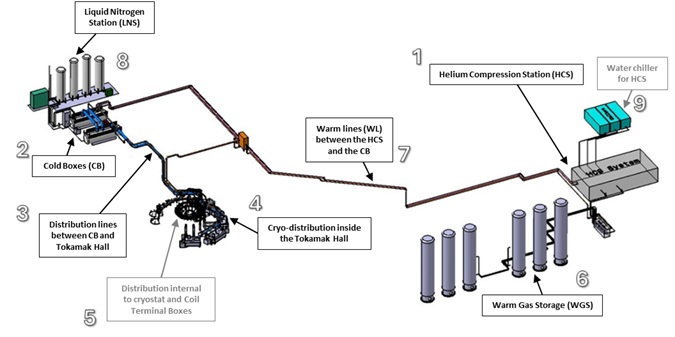
To manage this complexity, the DTT cryogenic system is organized into several integrated subsystems. A Helium Compression Station pressurizes warm helium to around 20 bar before it enters the cold boxes—large refrigeration units where cooling takes place -. From there, an extensive cryogenic distribution network transports helium from the cold boxes to the tokamak hall and into the cryostat, before returning it for re-cooling.
One of the most tailored design choices concerns helium distribution. Cryogenic users are grouped into parallel cooling loops, each controlled by a limited number of valves. This strategy stems from a practical constraint: the extremely limited space available for cryogenic valve boxes in the tokamak hall. Grouping magnets and other components significantly reduces the total number of control valves, optimizing costs and simplifying system management.
In essence, the DTT cryogenic system is far more than an auxiliary service—it is an enabling technology. Without it, superconducting magnets could not operate and plasma confinement would not be possible. The engineering solutions developed for DTT—from handling pulsed thermal loads to simplifying helium flow regulation—provide valuable insights for future fusion power plants. In a field where every watt of heat and every fraction of a degree matter, the “cold heart” of DTT represents a concrete step toward practical and sustainable fusion energy.
The technical documentation related to the DTT cryogenic system is complete and ready for publication; the call for tenders will be published shortly.